Dinosaur Named as New Species 102 Years After Fossil Found on Isle of Wight
A partial braincase stored unstudied in London's Natural History Museum since 1924 has been named Invictibellatrix amberina — a feathered, big-clawed predator and the first megaraptoran ever found in Europe, rewriting the dinosaur group's intercontinental story.
By NewsFlow Editorial Team••9 min read•Source: New Scientist
It waited a century in a museum drawer to get a name. A fossil braincase collected on the Isle of Wight in 1924 has finally been recognised as a new species of predatory dinosaur — Invictibellatrix amberina, "the unconquered female warrior" — after researchers used CT scanning to peer inside a specimen that had sat unstudied in the Natural History Museum in London for about 100 years.
The identification, led by Cassius Morrison, now at the University of Leeds, places the animal among the megaraptorans, a group of agile, big-clawed carnivorous dinosaurs related to Tyrannosaurus rex. If the classification holds, it is the first time a megaraptoran has ever been found in Europe — a discovery that redraws the map of where these predators roamed 120 million years ago.
A century in the archives
The fossil's journey began with Reverend Reginald Hooley, a clergyman and prolific fossil collector who gathered specimens from the Isle of Wight's cliffs in the early twentieth century. The partial braincase — the bony housing of the brain — entered the Natural History Museum's collections in 1924 and then, in Morrison's words, "was sitting unstudied in the museum for about 100 years, which is very surreal."
That century-long wait is less unusual than it sounds. The world's great natural history museums hold hundreds of millions of specimens, and backlogs of unstudied material are the norm rather than the exception. Fossils collected before modern analytical techniques existed often yield their secrets only when new technology — in this case, computed tomography — allows scientists to examine them in ways their discoverers never could.
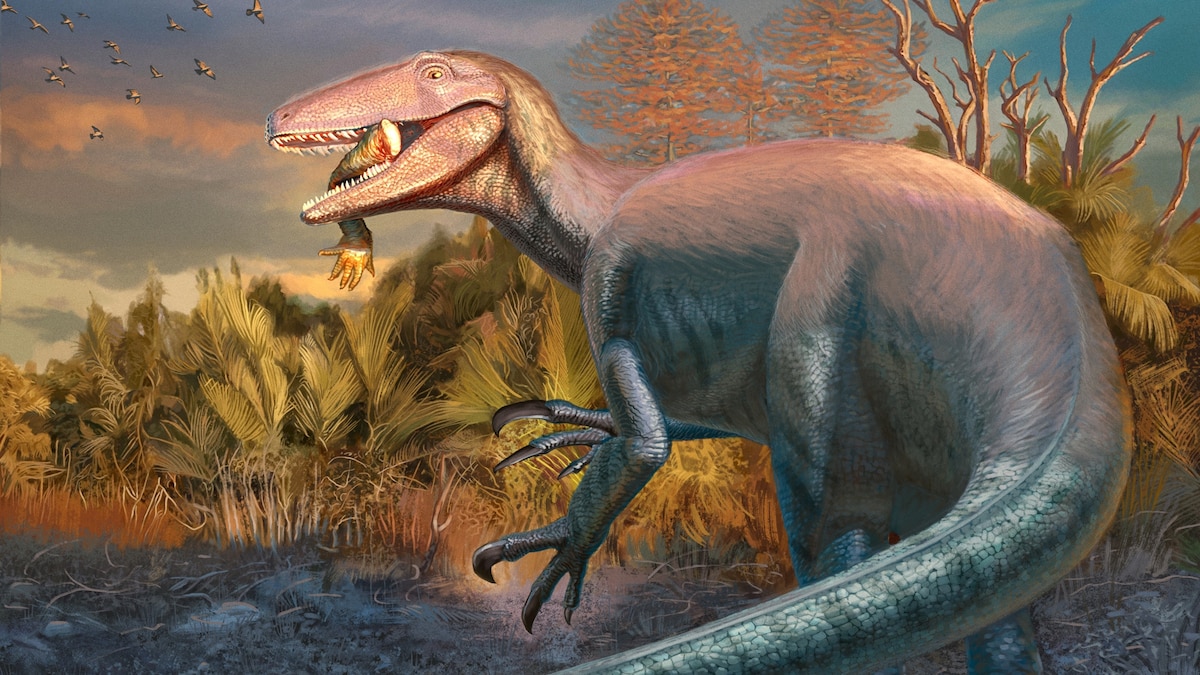
An artist's reconstruction of a megaraptoran — the group to which the new Isle of Wight predator belongs.
Morrison and his colleagues CT-scanned the braincase to build a detailed 3D model, then compared its anatomical features against a library of other dinosaurs. The closest match was Murusraptor, an Argentinian megaraptoran from about 80 million years ago. On that basis, the team concluded that the skull — recovered from 120-million-year-old rocks of the Lower Cretaceous Wessex Formation on the island's south-west coast — represents a new species within the Megaraptora.
Meet the unconquered warrior
The researchers estimate that Invictibellatrix was an agile, two-legged carnivore about 3 to 4 metres long, some 1.5 metres tall at the hip and weighing between 200 and 300 kilograms — roughly the size of a large lion, but built for speed rather than ambush. Like many theropods of its era, it was probably feathered, and it carried curved claws 10 to 20 centimetres long on its hands, weapons for slashing at small dinosaurs, lizards and early mammals.
"Humans would have been perfect-sized prey, about a third of their body weight," Morrison noted — a vivid reminder that had we walked the Earth 120 million years ago, we would have been on the menu. At the time, the Isle of Wight was not an island at all: it was firmly attached to mainland Britain and the rest of Europe, and the environment was subtropical — a lush floodplain crisscrossed by rivers, and one of the richest dinosaur habitats in what is now Europe.
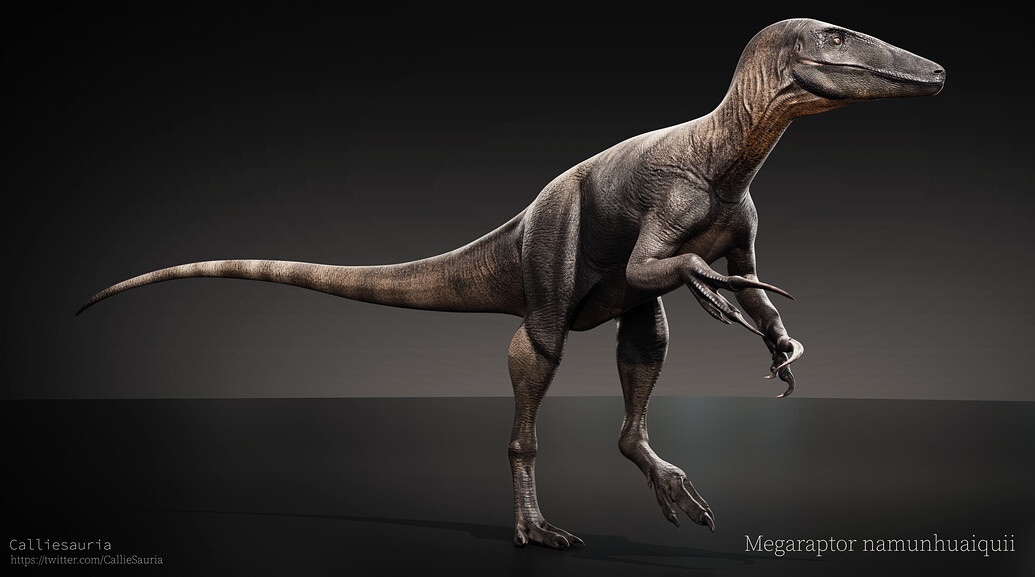
Megaraptorans were defined by their enormous hand claws — up to 20 centimetres long in the new species.
Plugging a gap in the dinosaur map
The real significance of the find is biogeographical. Until now, megaraptoran fossils had been found in Asia, Australia and South America — but never Europe. Finding one in Britain begins to tie their story together across the fragmenting continents of the Cretaceous.
Morrison suggests that Invictibellatrix evolved from Asian megaraptorans that dispersed into Europe some 130 million years ago. From there, the group spread into Africa, then onward to South America and Australia before the continents fully separated. It is a sweeping hypothesis of intercontinental migration, drawn from a single braincase — which is why other palaeontologists are urging caution.
Jake Kotevski of Monash University in Melbourne called it "a shame more detailed comparisons couldn't be made" with Eotyrannus, a 5-metre-long predator known from the Wessex Formation just a few million years earlier, which has previously been considered a possible megaraptoran relative. The problem is that none of the fossilised remains of the two animals directly overlap — you cannot compare a braincase with a skeleton that has no braincase — so their relationship remains unresolved. "If Invictibellatrix is indeed a megaraptoran, it expands the palaeobiogeographic range of the group and plugs a significant gap in our knowledge, linking those from South-East Asia to Australia and South America via Europe and Africa," Kotevski said. "However, more fossils are required to support or reject this hypothesis."
The Isle of Wight: Europe's dinosaur capital
The island's south-west coast, where the braincase was found, is one of the most productive dinosaur fossil sites in Europe. The Wessex Formation's cliffs around Brook and Compton Bay regularly surrender new material as erosion eats into the 120-million-year-old rocks, and the island has produced a roll-call of British dinosaurs — from the sail-backed Concavenator relatives to the heavyweight Iguanodon herds and the tyrannosaur cousin Eotyrannus itself.
For fossil hunters, the island remains an accessible pilgrimage: its beaches are public, its cliffs are crumbling helpfully, and its museums display finds from two centuries of collecting. Visitors budgeting a trip from abroad can check the currency converter for live pound exchange rates before booking.
What the Invictibellatrix story really illustrates, though, is that the age of discovery is not over — and that some of the most exciting finds of the next decade may already be sitting in museum drawers, waiting for a CT scanner and a curious researcher. A fossil collected by a Victorian clergyman, ignored for a century, has just rewritten the range map of an entire dinosaur group. There will be more.
Source: New Scientist — "Dinosaur named as a new species 102 years after its fossil was found on the Isle of Wight" (13 October 2026).
FAQs
What does the name Invictibellatrix amberina mean?
The genus name Invictibellatrix is Latin for "unconquered female warrior" — invicta meaning unconquered, bellatrix meaning a female warrior — chosen to evoke the animal's formidable claws and predatory lifestyle. Dinosaur species names traditionally combine a genus name with a species epithet; the authors selected amberina as the epithet for this particular fossil. Colourful, descriptive names like this have become a hallmark of modern palaeontology, replacing the drier conventions of the nineteenth century.
How can scientists name a new species from just a braincase?
The braincase — the fused bones enclosing the brain — is one of the most information-rich parts of a dinosaur skull. Its shape, the arrangement of nerve and blood-vessel openings, and the structure of the inner ear vary distinctively between groups, making it highly diagnostic. By CT-scanning the fossil and building a 3D model, Morrison's team could compare dozens of fine anatomical details against other theropods without damaging the century-old specimen. In theropod palaeontology, braincase anatomy has overturned classifications before, so a well-preserved one can carry real taxonomic weight.
What were the megaraptorans?
Megaraptorans were a group of medium-to-large theropod dinosaurs that lived roughly 130 to 66 million years ago, best known from South America and Australia. Their defining feature was a pair of enormous, sickle-like claws on their hands — in some species over 35 centimetres long — used for grasping and slashing prey. Their exact family tree is debated: they were once thought to be close to allosaurs, but recent work places them among the tyrannosauroids, making them distant cousins of T. rex. The European discovery suggests they were far more widespread than previously believed.
Why did the fossil sit unstudied for 100 years?
Museum collections are vast — the Natural History Museum in London alone holds around 80 million specimens — and there are far more fossils than palaeontologists to study them. Specimens collected in the early 1900s were often catalogued and shelved, awaiting a researcher with the right question and the right tools. Modern CT scanning has triggered a renaissance of "drawer discoveries": fossils that looked unremarkable to the naked eye reveal diagnostic internal anatomy under X-rays. Invictibellatrix is only the latest example of a backlog fossil becoming a headline species.
What was the Isle of Wight like when this dinosaur lived?
About 120 million years ago, during the Early Cretaceous, the Isle of Wight was part of a subtropical floodplain attached to mainland Europe — no English Channel, no island. Meandering rivers, forests and open plains supported a rich fauna: herds of iguanodontian plant-eaters, armoured dinosaurs, early mammals, crocodile relatives and a variety of predators including Invictibellatrix and the larger Eotyrannus. The Wessex Formation's mudstones and sandstones preserved this ecosystem in extraordinary detail, which is why the island is often called the dinosaur capital of Europe.
🤖 This article was rewritten by Feed and Figures' editorial AI from a report originally published by New Scientist. Facts and quotes are preserved from the original; the rewrite focuses on clarity and structure. For the unedited original, see the source link below.