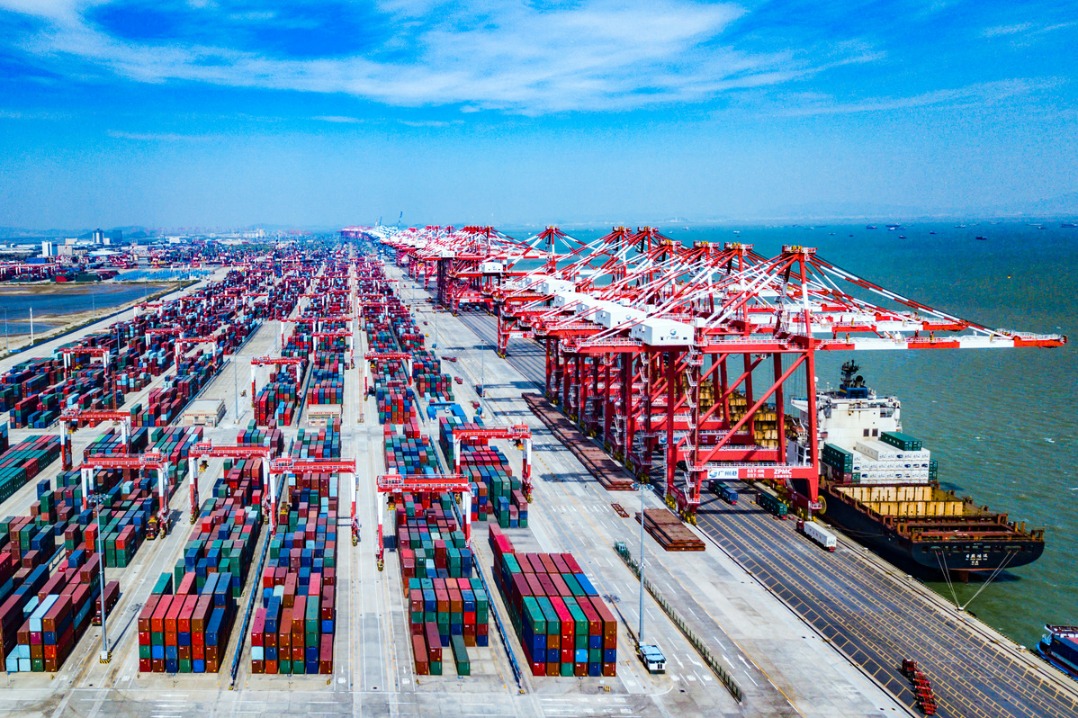
China's exports surged 36.3% year-on-year in September to a record $447.18 billion, official data showed on Wednesday — the fastest pace of export growth since early 2021 and a reading that smashed economist forecasts. The boom is being driven by the global artificial-intelligence buildout, with shipments of integrated circuits more than doubling and high-tech hardware leading the charge.
The September figure, released by the General Administration of Customs, demolished the consensus: a Reuters poll of economists had forecast 25.5% growth, following 25% in August. Imports also surprised to the upside, rising 31% to about $313.65 billion against a forecast of 24.5%. The monthly trade surplus widened to $133.53 billion — the largest since January 2025 and well above the $118.1 billion forecast.
The numbers confirm that the AI infrastructure cycle has become the single most powerful engine of China's export economy — and that the country's trade surplus is on track to top $1 trillion for a second consecutive year.
The headline numbers
The September data was extraordinary on almost every line:
- Exports: up 36.3% year-on-year to $447.18 billion — fastest growth since early 2021, versus 25.5% forecast.
- Imports: up 31% to ~$313.65 billion, versus 24.5% forecast and 28.2% in August.
- Trade surplus: $133.53 billion — the largest in 20 months, above the $118.1 billion forecast (August: $119.09 billion).
- US bilateral surplus: $34.01 billion in September, up from $29.18 billion in August.
- Year-to-date: in the first nine months of 2026, exports are up 21.3%, imports up 27.5%, and the cumulative trade surplus has reached $938.51 billion.
At the current run rate, the annual surplus will again sail past $1 trillion and could surpass 2025's record of $1.2 trillion — a figure that will sharpen the rebalance debate in Washington and Brussels.
What surged: the AI complex
The composition of the boom is the real story. Integrated-circuit exports hit $44.95 billion in September, up 136% year-on-year — the chips at the heart of the global AI data-centre buildout. Passenger-car exports jumped 64%. High-tech goods — semiconductors, servers and data-centre components, electric vehicles and batteries — are the categories carrying the headline.
A significant share of the dollar-value gain is price rather than volume. DRAM and high-bandwidth memory (HBM) prices have risen sharply on the global AI buildout, and memory chips are the single biggest swing factor in China's export value. That price effect cuts both ways: it inflates today's figures, and it will deflate them when the memory cycle turns.
The semiconductor resilience has company-level texture too. ChangXin Memory Technologies (CXMT), the world's fourth-largest DRAM maker, staged an $8.6 billion Shanghai IPO last month — one of the year's biggest listings. And the Financial Times reported that Tencent signed a roughly $7 billion, five-year deal to lease about 100,000 advanced AI chips via Oracle's Southeast Asian data centres — compute that never enters China, exploiting a known gap in US export controls. The AI supply chain, in other words, is finding ways around the barriers meant to contain it.
What drove it
Three forces combined to produce the September blowout. First, the global AI infrastructure buildout: hyperscalers are pouring hundreds of billions of dollars into data centres, sustaining voracious demand for Chinese high-tech hardware even as Washington tightens technology restrictions. Reuters' pre-data reporting noted the AI boom was keeping demand robust for Chinese high-tech products, with exports remaining the key growth driver amid lacklustre domestic demand.
Second, timing: a pre-Golden Week shipping push and front-loading amid holiday-season order flows concentrated shipments in September. Third, a friendlier trade backdrop: the US–China tariff truce was extended after last month's Trump–Xi summit in Washington, and yuan weakness against the euro aided shipments to Europe.
The import surge — 31% — matters too. It suggests the export machine is pulling in components and raw materials at a matching clip, consistent with genuine production strength rather than pure price inflation.
Is the wave cresting?
The sustainability question splits economists. The sceptical view, articulated by analyst Andrew Batson in late September before the data landed, is that the super-high AI-related growth rates will slow as memory-chip prices level off, with 2027 export growth "most likely converging toward the recent trend for products outside the AI complex, which is around 5–7%."
The logic is straightforward: today's 136% chip-export growth is flattered by the memory price cycle. When DRAM and HBM prices stabilise — as they eventually must — the year-on-year comparisons become much harder. The underlying volume story (servers, data-centre gear, EVs) may prove more durable, but it cannot indefinitely grow at triple-digit rates.
The optimistic counter is that the AI capital-expenditure cycle still has years to run, with hyperscaler spending plans stretching well into 2027 and beyond. Near-term, the watchpoints are whether the October holiday slowdown and the January truce deadline trigger another front-loading wave — or a cliff.
Trade tensions and what comes next
The record run feeds directly into the geopolitical argument over China's industrial model. The US and China extended their tariff truce by two months to 10 January and agreed to lower tariffs on $30 billion of "non-sensitive" goods each way — but semiconductors, EVs and batteries were deliberately excluded, and the average US tariff on Chinese goods remains roughly 20.5%, versus about 11% in the pre-tariff era. In October, the EU secured Beijing's agreement to halve hybrid-vehicle exports to the bloc.
With the annual surplus again marching past $1 trillion, pressure from Washington and Brussels over industrial overcapacity will intensify. The next round of the US–China AI dialogue is scheduled before the end of November, and the January truce deadline looms over everything.
For businesses and investors exposed to these flows, currency moves can amplify or erase trade margins. Our currency converter tracks live exchange rates across major trading currencies, and readers following how trade-driven growth interacts with hard assets can check our gold rate page.
FAQs
How fast did China's exports grow in September 2026?
Exports rose 36.3% year-on-year in US-dollar terms to $447.18 billion, according to the General Administration of Customs — the fastest pace since early 2021 and far above the 25.5% consensus forecast. Imports rose 31% to about $313.65 billion (forecast: 24.5%), and the monthly trade surplus widened to $133.53 billion, the largest since January 2025. In the first nine months of 2026, the cumulative surplus reached $938.51 billion.
What does "AI-related shipments" actually mean here?
It means the high-tech hardware complex feeding the global AI data-centre buildout: integrated circuits (exports up 136% to $44.95 billion in September), servers and data-centre components, memory chips (DRAM and high-bandwidth memory), and adjacent categories such as electric vehicles (passenger-car exports up 64%) and batteries. A large part of the dollar-value surge is price-driven — memory-chip prices have soared — rather than pure volume growth.
Why did the data beat forecasts by so much?
Three forces combined: (1) the AI infrastructure buildout, with hyperscalers spending hundreds of billions on data centres and sustaining demand for Chinese high-tech hardware; (2) a pre-Golden Week shipping push and front-loading of holiday-season orders into September; and (3) a stabilised trade backdrop — the extended US–China tariff truce after the September Trump–Xi summit, plus yuan weakness against the euro aiding EU shipments.
Will the export boom continue?
Opinions split. Sceptics, including analyst Andrew Batson, argue the super-high AI-related rates will fade as memory-chip prices level off, with 2027 growth converging toward the 5–7% trend for non-AI products. Optimists point to multi-year hyperscaler capex plans stretching into 2027 and beyond. Near-term watchpoints: the October holiday slowdown, the 10 January tariff-truce deadline (which could trigger another front-loading wave or a cliff), and the next US–China AI dialogue round before end-November.
What does this mean for US–China trade tensions?
The $1 trillion-plus annual surplus intensifies Western pressure over industrial overcapacity. The tariff truce extension to 10 January lowered duties on $30 billion of "non-sensitive" goods each way, but semiconductors, EVs and batteries were deliberately excluded, and the average US tariff on Chinese goods sits near 20.5% versus ~11% pre-tariff era. The EU has separately secured Beijing's agreement to halve hybrid-vehicle exports to the bloc. The surplus figures will be Exhibit A in every rebalance negotiation to come.
🤖 This article was rewritten by Feed and Figures' editorial AI from a report originally published by Reuters; General Administration of Customs of China. Facts and quotes are preserved from the original; the rewrite focuses on clarity and structure. For the unedited original, see the source link below.



