Deforestation Slowed Worldwide in 2025, but Brazil's Election Could Undo the Fragile Gains
Global deforestation fell 15% in 2025 to 7 million hectares, but the Forest Declaration Assessment warns the gains are fragile — Brazil's presidential runoff and a looming El Niño could send tree loss climbing again.
The world's forests caught a breather in 2025. After years of grim headlines, the rate at which humanity permanently destroys forests slowed by 15 percent, driven largely by a turnaround in Latin America, where Brazil's renewed enforcement against illegal clearing began to bite. For the first time in a long while, the numbers moved decisively in the right direction.
But the people counting the trees say the improvement may not survive the year. A new annual assessment warns that global progress is fragile and politically exposed: Brazil, the biggest contributor to the 2025 improvement, holds a presidential runoff on October 25 that could undo years of gains.
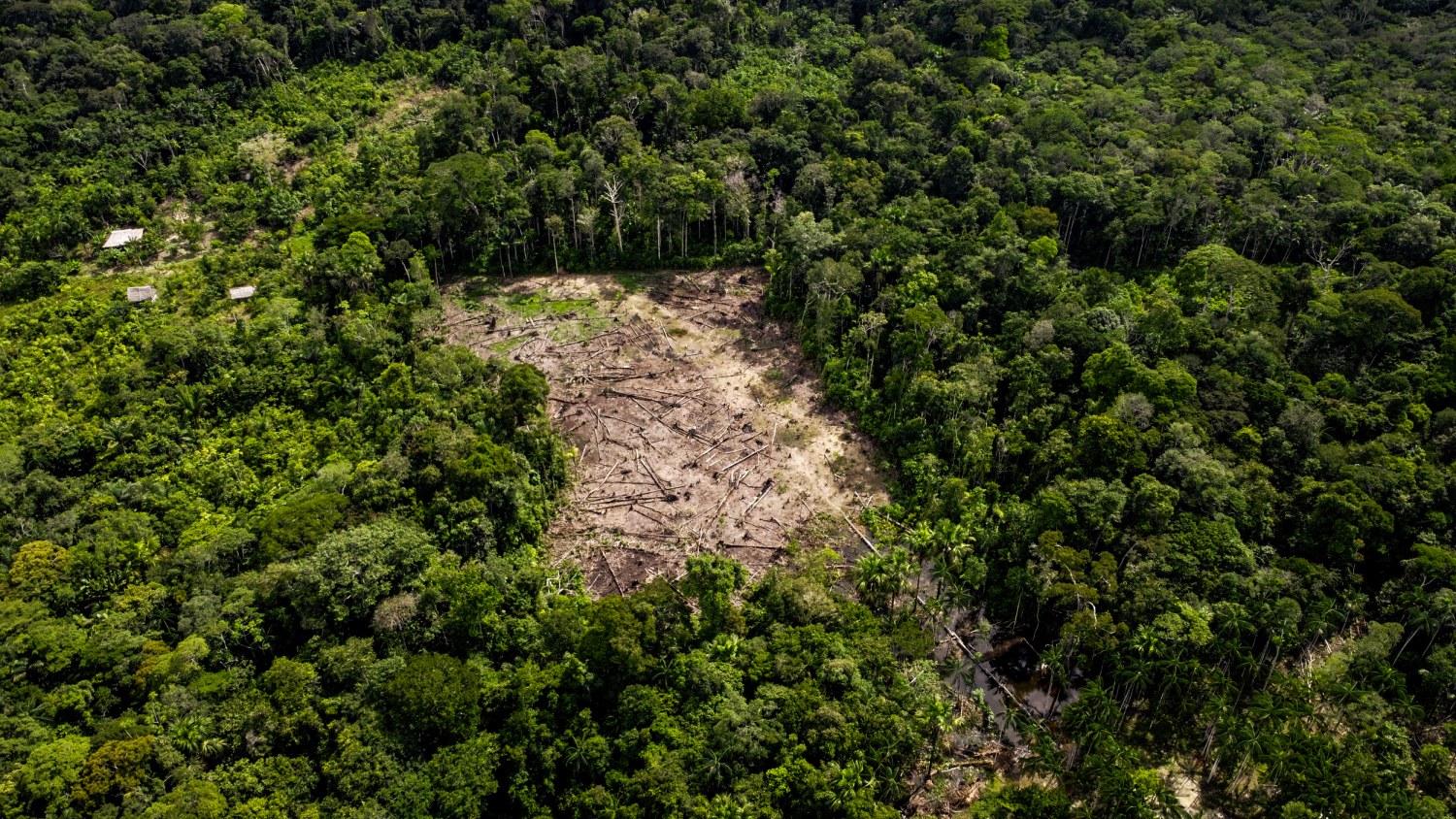
A cleared patch of deforested land cuts into the Amazon rainforest. Brazil drove most of the world's 2025 improvement — but an election runoff on October 25 could reverse the trend. (Photo: via NBC News)
The 2025 numbers, in context
Seven million hectares of forest were permanently destroyed in 2025 — an area roughly the size of the Republic of Ireland — according to the annual Forest Declaration Assessment, a report drafted by a coalition of research groups and non-governmental organisations. That is a 15 percent drop from the previous year.
Latin America drove the improvement. Deforestation fell by 33 percent in the region that has historically been the world's biggest forest-loss hotspot, with the report's authors pointing specifically to Brazil's national deforestation action plan and stepped-up enforcement in the Amazon. Agriculture and mining remain the leading global drivers of clearing, so the drop reflects genuine pressure being applied to the frontier.
Yet the authors are blunt about what the figure does not mean. It does not mean the world is on track to end deforestation by 2030 — the pledge agreed at the COP26 climate talks in 2021. To hit that target, forest loss would have to fall by roughly one million hectares every single year, a sustained decline the world has never managed. As study co-author Erin Matson put it, the 2025 figure is "encouraging but so far it's the exception, not a new trajectory."
Why it matters
Forests are one of the climate system's load-bearing walls. Tropical forests store enormous quantities of carbon, regulate rainfall far beyond their borders, and harbour a majority of the planet's land species. When a forest is permanently cleared, the carbon goes into the atmosphere and stays there — and the rainfall, biodiversity and livelihoods that depended on that forest do not come back on any human timescale.
The stakes are highest in the Amazon, where scientists have long warned of a potential tipping point: a threshold beyond which enough of the forest is cleared or degraded that large areas flip into a drier, savannah-like state that cannot be reversed. Such a shift would release vast carbon stores and disrupt the rainfall the forest carries across South America, affecting agriculture thousands of kilometres away.
The Congo Basin's loss is now running at nearly the same level as the Amazon's, for the first time.
Two-thirds of Brazil's greenhouse emissions come from land-use change, not fossil fuels.
Brazil did the heavy lifting
The 2025 turnaround has one main author: Brazil. When Luiz Inácio Lula da Silva returned to the presidency in 2023, his government rebuilt environmental enforcement — restoring agency capacity, satellite monitoring and on-the-ground operations under environment minister Marina Silva.
Lula, who is 80 and seeking re-election, has vowed to eradicate illegal deforestation by 2030. Early results suggest the promise has teeth: Brazil's official PRODES satellite system put Amazon deforestation at 5,731 square kilometres in 2025, around half the 2022 level and the fourth consecutive annual decline. In the first half of 2026, Amazon clearing fell to its lowest level in a decade, and loss in the Cerrado savanna hit its lowest point since 2021.
Brazil's election wildcard
On October 25, Lula faces right-wing populist senator Flávio Bolsonaro — son of former president Jair Bolsonaro, under whose administration Amazon deforestation surged — in a presidential runoff. Bolsonaro performed stronger than expected in the first round, and a consolidated right-leaning Congress, particularly in the Senate, would give him unusual latitude to reshape environmental policy.
The risk is not hypothetical. Brazil's president has wide executive power over environmental outcomes: he appoints the leadership of enforcement agencies like IBAMA, sets enforcement priorities and decides budgets that can strengthen or weaken protection within months. The report warns that Latin America's progress "rests heavily on the choices of a small number of governments and remains highly vulnerable" to exactly these kinds of political swings. The threat is not confined to Brazil either — hard-right presidents have recently been elected in Colombia and Peru, two other Amazon basin states.
Chatham House analysts note that much of Lula's achievement rests on enforcement regulations a new president could reverse by executive order, since they were never locked in with the structural reforms — land-tenure reform, supply-chain traceability and rural-credit conditions — that would make protecting forests more profitable than clearing them. If Flávio Bolsonaro follows his father's approach, he would likely gut enforcement capability and, with congressional backing, loosen environmental licensing and Brazil's forest code.
The election also touches Brazil's wider economic identity. The country has become the world's ninth-largest oil producer, and state oil company Petrobras paid R$277.6 billion in taxes in 2025 — about 7 percent of the country's total tax revenue. With China buying roughly 28 percent of Brazil's exports, trade pressure for stricter environmental standards has limited reach. Because Brazil's forest economy is so tightly bound to commodity exports and the value of the real, readers can follow what the figures mean in their own currency with Feed and Figures' currency converter.
Trouble on other fronts
Brazil is not the only reason for pessimism. Across the Atlantic, the Congo Basin — the world's second-largest tropical forest — is deteriorating fast. Rainforest loss there reached 2.4 million hectares in 2025, near parity with the Amazon for the first time. "Losing such a size of forest every year is a disaster," said Cameroonian environmental lawyer Sam Nguiffo, calling the losses effectively irreversible. Logging for timber and clearing for agriculture and mining dominate in Central Africa, and Nguiffo warns the erosion of the forest is fuelling conflict and devastating the livelihoods of local and indigenous communities.
Then there is the weather. An El Niño that emerged in June is expected to peak later this year and is already shaping up to be the strongest ever observed. El Niño brings drought to tropical forest regions, creating conditions for wildfires: tracts of forest and plantations in Indonesia's Borneo and South Sumatra have been burning for months. The last "super" El Niño, in 2015–16, produced a huge spike in tree-cover loss — and Matson cautions it is unlikely 2026 will repeat the reductions of 2025.
What happens next
The next few weeks will decide the shape of the next decade. The October 25 runoff is the immediate hinge: a Lula victory would likely keep the enforcement machinery running, while a Bolsonaro win could unwind gains within months through appointments, budgets and loosened licensing.
Beyond the ballot box, the strong El Niño will test whether 2025 was a turning point or an outlier. Drought and fire seasons in Indonesia, the Amazon and the Congo Basin over the coming months will show whether the world's forests can hold the line through hostile weather. The 2026 Forest Declaration Assessment will deliver the verdict. For now, the world's forests are holding their breath.
FAQs
What did the 2025 deforestation numbers actually show?
The annual Forest Declaration Assessment found that 7 million hectares of forest — roughly the size of Ireland — were permanently destroyed in 2025, a 15 percent drop from the previous year. The improvement was concentrated in Latin America, where deforestation fell 33 percent, with Brazil's enforcement-led action plan in the Amazon doing most of the work. That is a genuine fall in permanent forest destruction, not just a statistical quirk of fire seasons or degradation, and it came mainly from pressuring the agriculture and mining frontiers rather than from luck with the weather.
Why is a 15 percent drop not enough to meet the 2030 pledge?
The world pledged at the 2021 COP26 talks to end deforestation by 2030, and the maths of that commitment is unforgiving: forest loss would need to fall by roughly one million hectares every single year to get there. One good year of 15 percent, from a baseline of around 8 million hectares, leaves the world far short of that glide path. The report's authors therefore describe the 2025 result as an exception rather than a new trajectory — the kind of blip that has happened before without becoming a trend.
How much difference can one election in Brazil really make?
More than in almost any other country. Brazil's president directly appoints the leadership of enforcement agencies such as IBAMA, sets enforcement priorities and controls the budgets that determine whether protection works in practice. There is recent precedent for how fast things can change: Amazon deforestation surged under Jair Bolsonaro's presidency, was roughly halved after Lula returned in 2023 and rebuilt the enforcement machinery. Because many of Lula's gains rest on executive regulations rather than permanent structural reform, a new administration could weaken them within months.
What is happening in the Congo Basin, and why does it matter?
The Congo Basin, the world's second-largest tropical forest after the Amazon, lost 2.4 million hectares in 2025 — near parity with the Amazon for the first time. Its forests sit over vast carbon-rich peatlands, support extraordinary biodiversity, and underpin the cultural identity and livelihoods of millions of local and indigenous people; Cameroonian lawyer Sam Nguiffo calls the annual losses effectively irreversible. The drivers there differ from Brazil's: logging for timber alongside clearing for agriculture and mining, with weaker enforcement and governance than Latin America's headline cases.
What should we watch for in 2026?
Three things. First, Brazil's October 25 runoff, which will decide whether enforcement budgets and agency leadership survive. Second, the exceptionally strong El Niño expected to peak later this year — the last "super" El Niño in 2015–16 caused a huge spike in tree-cover loss, and fire seasons in Indonesia, the Amazon and the Congo Basin will test whether 2025's gains can survive hostile weather. Third, whether any government moves beyond policing toward structural change: land-tenure reform, supply-chain traceability and credit conditions that make standing forests pay.
🤖 This article was rewritten by Feed and Figures' editorial AI from a report originally published by Climate Change News. Facts and quotes are preserved from the original; the rewrite focuses on clarity and structure. For the unedited original, see the source link below.