America's AI Race Threatens Indigenous Lands in the Philippines
The US-led Pax Silica pact plans a 4,000-acre AI and semiconductor hub in Central Luzon — on land Aeta Indigenous communities call their ancestral domain, sparking protests, a mass petition and a congressional budget fight.
By NewsFlow Editorial Team••9 min read•Source: Grist
On 10 September, Philippine President Ferdinand Marcos Jr. arrived at the Grand Hyatt Manila to address hundreds of foreign business representatives at the Luzon Economic Corridor investors' forum. Outside the hotel, hundreds of demonstrators carried signs reading "No to Pax Silica!" — and were met by police with riot shields and batons.
The clash captured, in a single scene, what the United States' race to dominate artificial intelligence now means for the Philippines: a vast planned technology hub that Washington calls an economic opportunity, and that Indigenous and farming communities call an international land grab carried out in the name of American AI ambitions.
According to an investigation by Mongabay, republished by Grist, the Pax Silica initiative — a US-led global pact to build an AI and semiconductor supply chain independent of China — plans a 4,000-acre high-tech manufacturing hub in Central Luzon. The site sits inside New Clark City, overlapping with the ancestral land claims of the Aeta, among the earliest settlers of the Philippine archipelago.
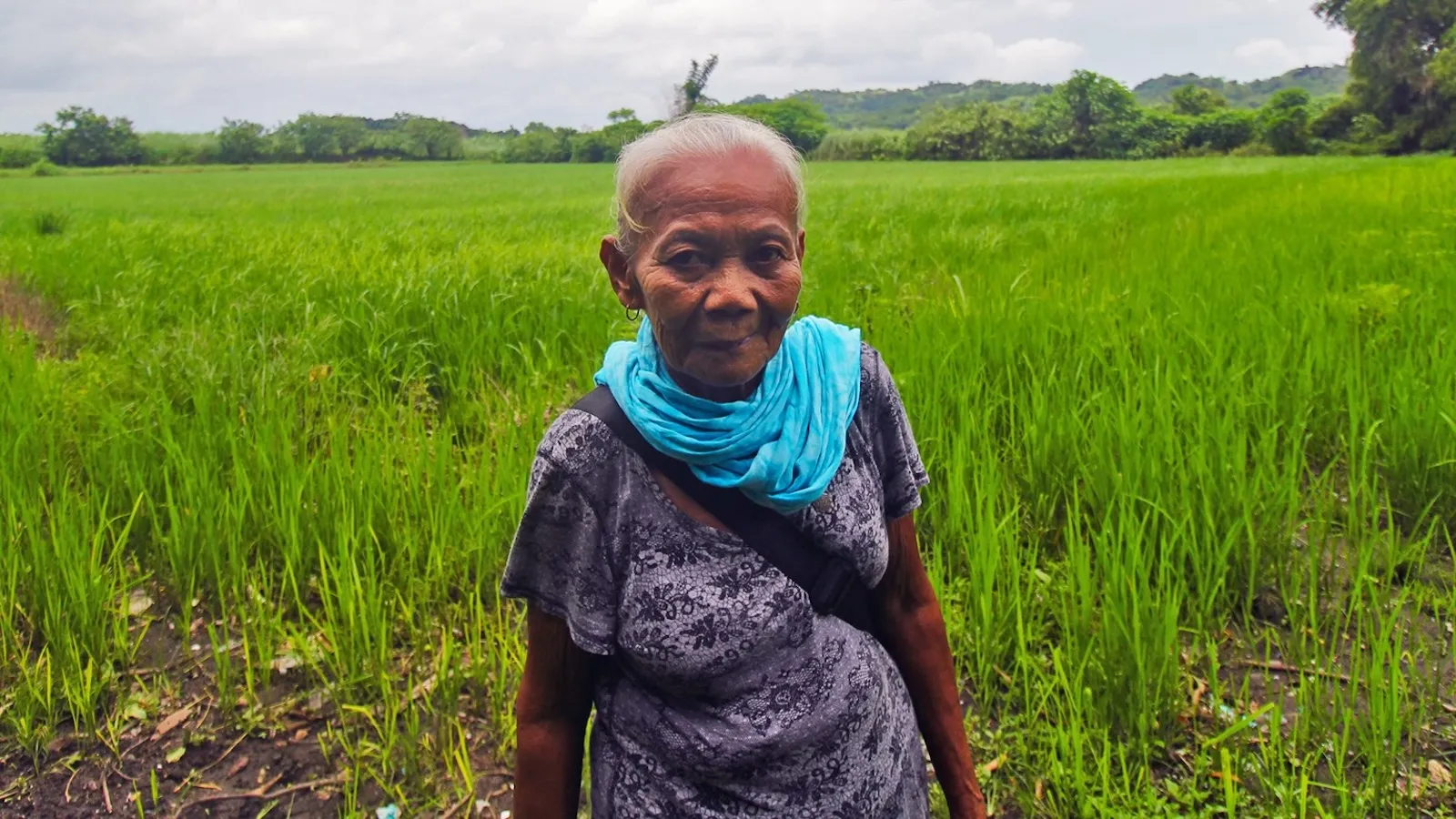
Gloria Capiz-Estabillo, 76, an elder of the Aeta Hungey tribe, on land the community says is its ancestral domain. (Image: Michael Beltran for Mongabay / Grist)
What Pax Silica is
The Luzon Economic Corridor (LEC) is an economic initiative focused on the Philippines' biggest island, launched in 2024. Pax Silica folds the corridor into a wider US-led pact — now involving some 25 nations — aimed at securing the supply chains for artificial intelligence and semiconductors without relying on China.
In April, Washington and Manila announced plans to build the 4,000-acre hub in Central Luzon. In July, US Secretary of State Marco Rubio visited Manila to reaffirm bilateral commitment to the project, and a final agreement is slated for signing in November.
The protest at the Grand Hyatt
The September investors' forum gave the opposition its most visible moment yet. Activists say police injured at least 27 protesters and arrested five; police, in turn, reported minor cuts and injuries to 16 of their personnel. Jona Yang, a protester from the activist-scientist group AGHAM, said she was negotiating with police to cool tensions when they arrested her.
The demonstrations have continued since. A petition against Pax Silica has reportedly gathered nearly 400,000 verified signatures, according to the Philippine Star, and an opposition caravan of 60 vehicles and more than 1,000 supporters recently converged on Capas, Tarlac.
An energy and water appetite on a national scale
The resource demands of the planned hub are what turn an industrial project into an environmental flashpoint. BCDA chief Joshua Bingcang offered what he called a "conservative" estimate: the facility would need around 3 gigawatts of energy to run — about 26.3 terawatt-hours a year, nearly as much as the Philippines' entire service sector consumed in 2024.
Bingcang said the facility would be green and mainly solar powered. But Giovanni Tapang, former dean of the University of the Philippines' College of Science, asked how many thousands of hectares would be taken from farmers to build the solar panels — and why domestically generated clean energy should serve US industry rather than local households.
Water is the other pressure point. Bingcang said the hub would consume 16 to 24 million gallons of water a day, sourced from rainwater via an impounding dam. Tapang voiced concern about the dry season, which runs from December to May: "This is the same period where farmers need their water for irrigation."
On data centres, the development authority initially said data centres could be part of Pax Silica, but Bingcang and the president's office later denied this in a September briefing. A document shared at the LEC forum, however, listed data centres as part of the planned infrastructure in New Clark City.
The Aeta communities in the way
The Pax Silica site lies within the 23,350-acre New Clark City, itself part of the greater 79,000-acre Clark area — a former US military complex established in 1903, when the Philippines was under American colonial rule, and returned to Philippine control in 1991. Long before the base, historians argue, the area was the ancestral territory of the Aeta.
A land survey by Arnisson Andre Ortega, a professor at Syracuse University, found that planned construction for Pax Silica would impinge on the lands of at least three existing Aeta villages. Gloria Capiz-Estabillo, 76, an elder of the Aeta Hungey tribe, told Mongabay that the BCDA has already begun informing Aetas they need to leave the land.
"They're setting up right in the middle of our land. Where are we going to live? How about our crops? Where will they take us, just drop us in the ocean?" Estabillo said. "They'll have to kill us to take us off this land."
A title the government says does not exist
"There is no ancestral domain title in that area," Bingcang said, denying that the project would displace anybody. That denial is the crux of the legal dispute. To gain formal land rights, Indigenous peoples must apply for a certificate of ancestral domain title from the National Commission on Indigenous Peoples — and Aetas in Clark have been lobbying for one since 1994, beset by decades of delays.
Lawmakers have pressed the point. In budget hearings, legislators challenged a proposal offering up to 4,000 acres rent-free for two years as an "in-kind contribution" to a Pax Silica coordination office. The House appropriations panel suspended proceedings on the BCDA's 2027 budget, demanding documentation including environmental compliance certificates.
A global pattern of AI's resource footprint
What is happening in Central Luzon fits a worldwide pattern. The AI boom is extraordinarily resource-hungry: training and running large models demands vast electricity, data centres require enormous volumes of water for cooling, and the semiconductor supply chain depends on critical minerals whose extraction scars landscapes and communities.
Around the world, that footprint is landing disproportionately on Indigenous and rural communities. The Philippines case is distinctive mainly in its scale and its explicit geopolitical framing: an entire economic corridor designed to decouple the AI supply chain from China.
What happens next
The final Pax Silica agreement is slated for signing in November, and officials continue to insist the project will remain subject to Philippine laws and regulatory requirements. The Department of Agrarian Reform has said it has not received any land-conversion application for the hub — a sign of how much remains unresolved.
Opposition shows no sign of abating. With a mass petition, congressional scrutiny, a deferred agency budget and Aeta communities vowing not to move, the November signing will test whether the project can proceed on the government's terms.
FAQs
What is Pax Silica?
Pax Silica is a US-led international pact — now involving around 25 nations — to build an artificial intelligence and semiconductor supply chain that does not rely on China. In the Philippines, it centres on the Luzon Economic Corridor, where Washington and Manila announced in April that a 4,000-acre high-tech manufacturing hub would be built in Central Luzon. A final agreement is slated for signing in November, following a July visit to Manila by US Secretary of State Marco Rubio.
Who are the Aeta, and why are they affected?
The Aeta are Indigenous peoples considered among the earliest settlers of the Philippine archipelago, and the Clark area was historically their ancestral territory. A land survey found that planned Pax Silica construction would impinge on the lands of at least three existing Aeta villages, and residents of the hamlet of Sapang Kawayan say they have already received relocation letters. Aetas in Clark have been seeking a formal certificate of ancestral domain title since 1994, but the process has stalled for decades.
Why does the government say nobody will be displaced?
The Bases Conversion and Development Authority, which manages the site, says there is no formal ancestral domain title in the area and therefore denies the project will displace anyone. Critics counter that the absence of a title reflects decades of bureaucratic delay, not the absence of a claim — the Aeta Hungey community has an active title application dating to 1999, refiled in 2021. A House panel has deferred the authority's 2027 budget until it produces documentation, including environmental clearances.
What are the environmental stakes?
The hub would need around 3 gigawatts of power — about 26.3 terawatt-hours a year, nearly matching the entire Philippine service sector's 2024 consumption — plus 16 to 24 million gallons of water daily, competing with farmers' irrigation needs during the December-to-May dry season. The site is also slated for mineral-processing technology, and campaigners warn of long-term contamination risks. The development authority says the facility will be green and mainly solar powered, but has not detailed waste management plans.
What happens next?
The final agreement is due to be signed in November. Before then, the government faces a suspended agency budget, congressional scrutiny, a petition with nearly 400,000 signatures, and continued protests from farming and Indigenous communities. Whether the project proceeds on schedule will depend on how — and whether — the land-rights dispute over Aeta ancestral territory is resolved.
🤖 This article was rewritten by Feed and Figures' editorial AI from a report originally published by Grist. Facts and quotes are preserved from the original; the rewrite focuses on clarity and structure. For the unedited original, see the source link below.