Science Corporation's PRIMA Vision Chip Gives Sight Back to First Stargardt Disease Patient
Science Corporation has implanted its PRIMA vision-restoring chip into its first Stargardt disease patient, who read a word in his second rehabilitation session. The milestone, announced by CEO Max Hodak at TechCrunch Disrupt, extends the retinal implant beyond its European approval for geographic atrophy — and advances the Neuralink co-founder's wider brain-computer interface ambitions.
By NewsFlow Editorial Team••11 min read•Source: TechCrunch
A blind spot that only ever grows. For people living with Stargardt disease, an inherited eye condition that methodically destroys central vision, there has never been a treatment — let alone a reversal. That may finally be changing. Science Corporation, the neural engineering startup founded by Neuralink co-founder Max Hodak, has implanted its PRIMA vision-restoring chip into its first patient with the disease, and the early results are remarkable: during the patient's first rehabilitation session he saw a letter, and during the second he was able to read a word.
Hodak announced the milestone on stage at TechCrunch Disrupt, folding it into a much broader argument about where brain-computer interfaces are heading. "The retina is part of the central nervous system," he said. "We consider cochlear implants, retinal prostheses, motor prostheses — these are all different types of BCIs." For Science Corporation, restoring vision is not the end goal but the proving ground: a way to demonstrate that the company's neural engineering methods work, and to build a sustainable business around them.
Why Stargardt disease matters
Stargardt disease is one of the most common forms of inherited macular degeneration, and it is currently considered incurable. It attacks the outer retina, gradually killing off the light-sensing cells — the photoreceptors — while potentially sparing the inner retina, the neural circuitry that carries visual signals onward to the brain. The result is a central blind spot that enlarges over time, eventually wiping out the detailed vision needed for reading, recognising faces and driving. An estimated 150,000 people around the world have lost vision to the disease.
That pathology is exactly what makes Stargardt a promising target for PRIMA. The chip does not attempt to repair the dying photoreceptors; it replaces them. Because the inner retina often survives in Stargardt patients, there is still living circuitry waiting to be stimulated — a biological wiring harness that the implant can plug into. "Vision is electrical potential, electrical activity down the optic nerve," Hodak explained. "That's all vision is to the brain, and so if you can get the optic nerve to signal the rest of the brain correctly, then you can provide vision to it."
How the PRIMA implant works
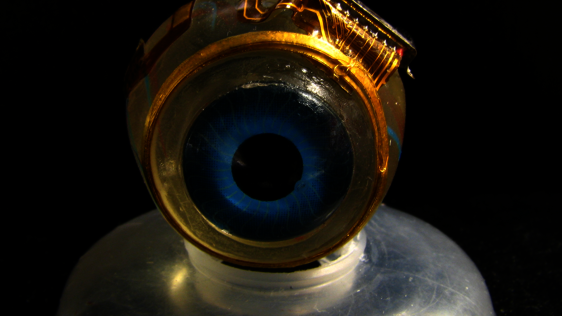
The procedure is strikingly brief for something so ambitious. In an hour-long operation, surgeons place the small chip in the back of the eye, in the precise region where the photoreceptors have degenerated. The patient then wears camera-equipped glasses that capture the world in front of them and transmit that image wirelessly to the implant. The chip, studded with hundreds of tiny electrodes, converts the incoming signal into electrical pulses that stimulate the surviving retinal cells — effectively acting as artificial photoreceptors.
PRIMA acts as an artificial layer of photoreceptors, converting camera signals into electrical pulses for the surviving retina.
The implant in the Stargardt patient is just two millimetres by two millimetres — roughly the size of a large grain of sand. "It's like looking through a straw," Hodak said. "It is not a big field of view colour vision. It's a patch in their central vision where... it's black and white, but it is sharp. It's high-contrast sharp, and so they can see a couple of letters at a time."
That may sound modest, but it is worth pausing on what it means. Central vision is precisely what Stargardt steals, and even a small, sharp, monochrome window onto the world can restore reading — one of the most consequential losses of independence that comes with blindness. For a disease with zero approved treatments, a patient reading a word after two rehab sessions is not incremental; it is a line being crossed.
The trial at Sydney Eye Hospital
The company says the first Stargardt patient received the implant in May as part of its ongoing trial at the Sydney Eye Hospital in Australia. The choice of site is notable: Australia's regulatory environment has made it an increasingly popular launchpad for neural interface trials, offering a faster path from bench to bedside than the US Food and Drug Administration's typically longer review cycles.
PRIMA is already commercially available in Europe for patients who have lost sight to geographic atrophy, an advanced form of age-related macular degeneration. Extending it to Stargardt is the company's bet that the same fundamental approach — bypassing dead photoreceptors and stimulating the surviving inner retina — generalises across diseases of the outer retina. The underlying technology was originally developed through years of academic research before Science Corporation acquired and commercialised it.
The PRIMA implant is placed in an hour-long procedure at the back of the eye, where the photoreceptors have degenerated.
Source: TechCrunch — "Science Corporation implants its vision-restoring chip in its first Stargardt disease patient" (13 October 2026).
The road to native acuity
Hodak was candid about the device's current limitations and unusually specific about the engineering path past them. Making the field of view bigger, he said, means confronting the curvature of the eye: a flat 2mm chip works on the relatively flat back of the retina, but a larger implant must bend. At the same time, the electrodes must get smaller so that resolution approaches native levels of detail.
"I think we have a clear path," Hodak said. "There's a next generation that's being worked on that'll be in humans in the next year, and over the next five years, I think we'll be able to get pretty close to native acuity." That timeline — a bigger, curved, higher-density implant in humans within twelve months — would put Science Corporation ahead of the handful of other companies and academic groups pursuing electronic retinal prostheses.
The field has a complicated history. Earlier retinal implants, including the well-known Argus II, demonstrated the concept but struggled commercially, with one manufacturer eventually discontinuing its device and leaving patients with orphaned hardware in their eyes. Science Corporation's answer to that legacy is a sustainable business model built on a clear clinical indication, manufacturing discipline and regulatory progress — and, evidently, expanding into new indications like Stargardt.
The bigger bet: brain-computer interfaces
Vision restoration is only the opening chapter. Science Corporation's long-term ambition is a novel brain-computer interface, and Hodak laid out a roadmap that starts in the clinic and ends somewhere philosophical. The company's BCI sensor will be implanted inside the skull but rest on top of the brain — unlike Neuralink's device, which is inserted directly into brain tissue. That design trades some signal fidelity for a less invasive procedure, a calculation that could matter enormously for regulatory approval and patient acceptance.
The first clinical applications of the BCI are closer than the company's public announcements suggest. "Our first clinical indication, which hasn't been announced publicly, is a neurodegenerative disease that everybody's heard of," Hodak said. The company is also exploring stroke: "If you've lost part of your brain because it's been dead due to stroke, if you can get connections into the deep brain in two different areas, you can imagine adding new cortical areas, just like adding new brain areas entirely — something simply not possible with conventional electrodes." The device could also help monitor neurological activity in patients with brain tumours.
And beyond that? "The long-term mission of the company is to understand how the brain creates the mind and to learn to build engineered brains," Hodak said. He argued that brain-computer interfaces will eventually be mainstream: "I think we have a clear view that many people will eventually need some kind of BCI by the age of 60 or 70." The framing was medical rather than transhumanist: "We want to figure out how do we extend not just lifespan but health span."
A business built on proof
When Hodak founded Science Corporation in 2021 after leaving Neuralink, the company sketched plans for advanced neural engineering and brain-computer interface technology. But it deliberately chose to start with something it could prove: restoring vision. The logic is that a company with a real product, real patients and real revenue can fund the decade-long work of building novel neural interfaces — rather than burning venture capital on pure research.
As medtech investors track how much capital flows into neurotechnology startups, many keep an eye on cross-border deal values; the currency converter shows how dollar-denominated funding rounds translate into local currencies for international backers.
The Stargardt implant is the clearest evidence yet that the strategy is working. A single patient reading a word will not change the world on its own — but it is the kind of result that turns a research programme into a clinical one. If the next-generation device reaches humans next year as promised, and if five years brings the field genuinely close to native acuity, the conversation about vision restoration will shift from whether it is possible to how widely it can be offered. For the 150,000 people who have lost vision to Stargardt disease, that shift cannot come soon enough.
FAQs
What is Stargardt disease, and why is it so hard to treat?
Stargardt disease is an inherited form of macular degeneration, usually caused by mutations in the ABCA4 gene, that destroys the light-sensing cells of the outer retina from childhood or young adulthood. It is hard to treat because the damage is genetic and progressive: drugs cannot easily replace dead photoreceptors, and gene therapies for ABCA4 have been stalled by the gene's large size, which exceeds the carrying capacity of standard viral delivery vectors. That is why a device-based workaround — bypassing the dead cells entirely — is such an attractive alternative.
How is PRIMA different from earlier bionic eyes like Argus II?
PRIMA is a wireless, photovoltaic subretinal implant: it is powered and driven by infrared light projected from the camera glasses, so it needs no wires or implanted battery. The Argus II, by contrast, used an external camera wired to an electrode array on the retina's surface and required a cable through the eye wall. PRIMA's 2mm-by-2mm chip with 378 electrodes also targets higher resolution, and its commercial availability in Europe gives it a regulatory footing earlier devices never secured.
What did the first Stargardt patient actually experience?
According to Science Corporation, the patient received the implant in May at Sydney Eye Hospital and began visual rehabilitation afterwards. In the first session he perceived a letter; in the second, he read a word. Rehabilitation matters because the brain must learn to interpret the implant's black-and-white, high-contrast phosphene patterns as meaningful shapes — the vision is real but unfamiliar, and reading requires training the visual cortex to decode the new signal.
When could this become available to ordinary patients?
PRIMA is already CE-marked and commercially available in Europe for geographic atrophy, but the Stargardt application is still in clinical trials, so widespread availability for that indication is years away. Hodak says a next-generation device with a larger field of view will be in humans within a year, with near-native acuity targeted within five years. Even then, rollout will depend on trial outcomes, regulatory approvals in each market and the cost of the surgery plus rehabilitation programme.
What is Science Corporation's ultimate goal with brain-computer interfaces?
The company's stated long-term mission is to understand how the brain creates the mind and to learn to build engineered brains. Nearer term, its BCI — designed to sit on the brain's surface rather than inside tissue — is aimed at neurodegenerative disease, stroke rehabilitation and brain tumour monitoring. Hodak believes BCIs will eventually be routine medical devices for people in their sixties and seventies, framed around extending health span rather than lifespan.
🤖 This article was rewritten by Feed and Figures' editorial AI from a report originally published by TechCrunch. Facts and quotes are preserved from the original; the rewrite focuses on clarity and structure. For the unedited original, see the source link below.