Mini Human Intestines, Shipped by Post: The Startup Selling Drugmakers a Way Out of Animal Testing
Denver startup Intero Biosystems is shipping millimetre-scale lab-grown human intestines to drugmakers as a more human-relevant alternative to animal testing. Here is the science, the regulatory tailwind, and the evidence still to come.
By NewsFlow Editorial Team••11 min read•Source: TechCrunch
Imagine ordering miniature human intestines through the post, a hundred at a time, to test your next drug candidate on something closer to a person than a mouse. That is the proposition from Intero Biosystems, a seven-person Denver startup that took the stage at TechCrunch Disrupt this week as one of 20 finalists in the Startup Battlefield. Its flagship product, GastroScreen, is a vial of lab-grown intestinal organoids — millimetre-scale clusters of living gut tissue — sold to pharmaceutical, biotech, food and chemical companies as a more human-relevant alternative to animal testing.
The pitch lands at a moment of regulatory tailwind. Drug development has relied on animal models for nearly a century, yet species differences mean results often fail to translate, and most candidates still collapse before the clinic. Intero's bet is that drugmakers, nudged by American laws and guidance that permit non-animal methods in some cases, will increasingly prefer screening compounds on tissue that is actually human.
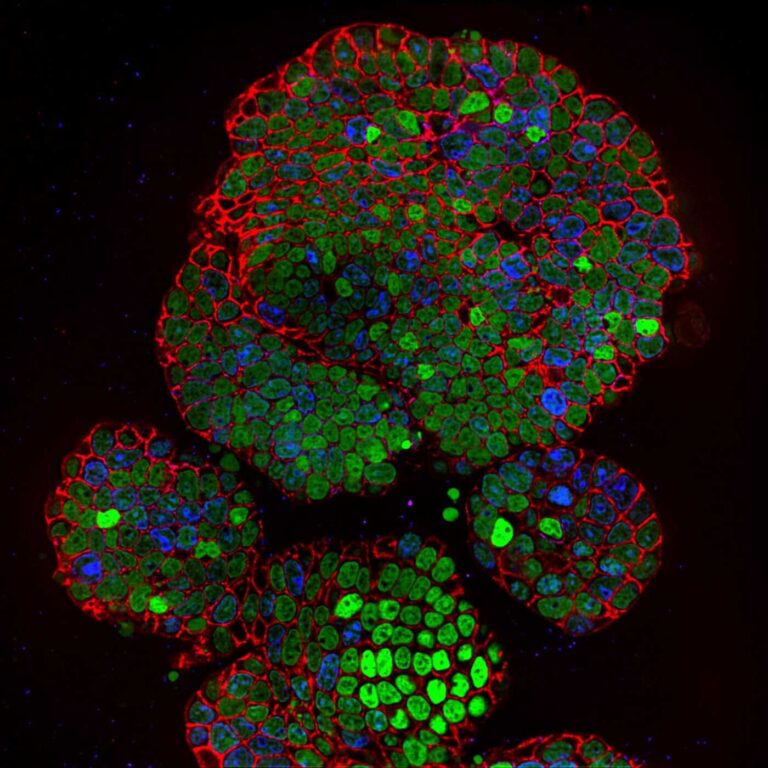
A lab-grown intestinal organoid visualised under a microscope. Intero Biosystems ships similar millimetre-scale organoids to drugmakers in batches of around 100. (Image: confocal.nl)
What Intero is building
Each GastroScreen organoid measures about one millimetre across. Customers receive roughly a hundred of them in a single tube and can either study them as healthy intestinal tissue or nudge them into disease-like states before dosing them with experimental compounds. Co-founder and chief executive Charlie Childs summed up the logistics with a memorable line: "We're literally shipping mini living organs in the mail to people."
Spun out of the University of Michigan in 2024, Intero insists its organoids go beyond simpler gut models on the market. Rather than reproducing one slice of intestinal biology, GastroScreen incorporates multiple cell and tissue types found in the human gut, co-founder and chief technology officer Madeline Eiken told TechCrunch.
The manufacturing method matters. Instead of growing models from intestinal tissue harvested during procedures such as colonoscopies, Intero derives its organoids from induced pluripotent stem cells — adult cells reprogrammed to develop into nearly any cell type. Because the starting cells can come from an ordinary blood draw, the approach is easier to scale and could eventually allow models to be personalised to individual patients.
The science of a mini-gut
Organoids are among the most fertile ideas in modern biology: stem-cell cultures that self-organise into three-dimensional structures resembling real organs. They sit alongside organs-on-chips — microfluidic devices that recreate aspects of a tissue's living environment — and both target the same weakness of traditional preclinical work: animal models that are whole organisms but the wrong species, versus flat human cell cultures that are the right species but biologically impoverished.
The gut is a particularly valuable organ to model because so much drug behaviour plays out there: absorption, metabolism and the gut toxicity that derails otherwise promising compounds. A 2019 study from Emulate, a Harvard Wyss Institute spin-off, illustrated how far the field has come when its duodenum-on-a-chip expressed CYP3A4 — an enzyme thought to metabolise about half of all marketed drugs — at levels comparable to the human gut. Since then the literature has pushed toward multi-organ systems linking intestine, liver, kidney and skin equivalents to profile drug behaviour over weeks.
Intero is not alone in this niche. Altis Biosystems builds stem cell-derived intestinal models, InSphero supplies patient-derived intestinal organoids aimed at gastrointestinal toxicity testing, and MIMETAS takes the microfluidic organ-on-chip route. Intero's claimed edge lies in combining multi-cell complexity with a reprogrammable-stem-cell route that can scale where biopsy-dependent methods cannot.
A business, not just a breakthrough
Founded only in 2024, Intero already has commercial numbers to show: a $2.3 million pre-seed round last year and more than $400,000 in revenue from the final quarter of last year through the third quarter of this one, serving just under ten customers. Readers following along can translate those dollar figures into rupees at the live rate using the site's currency converter.
The revenue mix is broader than vials of organoids. Intero sells the consumables researchers need to culture the tissue — nutrient mixes, reagents — and also acts as a contract research outfit, designing custom experiments, running laboratory tests and returning the data. Much of that service work centres on drug safety: exposing organoids to a candidate drug to check for gut toxicity, or dosing disease-modelled tissue to see how it responds.
There is a second, longer-range revenue idea. Intero does not use artificial intelligence to construct its organoids, but it sees the tissue as a data-generation engine: vast, standardised sets of biological responses that AI models are hungry for. The company plans to license such datasets to pharmaceutical and AI firms.
Why it matters: the slow turn away from animal testing
The deeper story is regulatory. In December 2022, the FDA Modernization Act 2.0 became law in the United States as part of the Consolidated Appropriations Act, signed by then-president Joe Biden. For the first time since 1938, drug sponsors were no longer legally required to run animal studies before filing for human trials; they could use scientifically validated alternatives including cell-based assays, organoids, organ chips and computer modelling. The law did not ban animal testing, but it ended its mandatory status.
Momentum has kept building. In April 2025, the FDA laid out plans to reduce its reliance on animal testing, explicitly naming organoids, organs-on-chips and AI-based computational models as alternatives. Then in March this year, the agency issued draft guidance on validating so-called new approach methodologies — NAMs — for use in regulatory submissions, offering a framework without endorsing any single method.
The urgency is not only ethical but economic. Animal-welfare campaigners cite the striking statistic that around 90 to 95 per cent of drugs that pass animal testing go on to fail in human clinical trials, wasting years of development time. Even setting aside the precise figure, the translation gap between species is widely acknowledged as one of the costliest bottlenecks in medicine — and human-relevant models that flag failures earlier promise cheaper development and faster paths for patients.
The evidence question
The honest caveat, which Intero's own chief executive volunteered, is that the evidence base is still being assembled. When TechCrunch asked what shows GastroScreen predicts human drug responses better than existing models, Childs said the company is midway through a three-stage validation programme. Stage one established that the organoids contain the key tissues of the human gut. Stage two — under way now — doses the tissue with well-known drugs whose human effects are documented, and GastroScreen has so far shown the expected responses to drugs that calm intestinal inflammation and to compounds known to injure the gut.
Stage three is the decisive one: direct comparison of GastroScreen results against pharmaceutical companies' existing animal and clinical data. Those studies are running now with several drugmakers, using both established compounds and new candidates. Sophisticated customers will not retire animal models on a startup's say-so; they will want to see the numbers.
What happens next
The near-term challenge is industrial. Intero currently produces a few thousand organoids at a time and is automating manufacturing to target hundreds of thousands per batch — the scale that turns a laboratory curiosity into a catalogue product, and into the datasets it hopes to license to AI developers.
Longer term, the ambitions stretch further. The company wants to move into personalised medicine, growing organoids from an individual patient's own cells so different drugs can be tested on that person's tissue before treatment begins. Its most audacious goal, by Childs's own description, is an artificial intestine — a project that would draw on both the manufacturing scale and the patient-specific data the organoid business generates.
Whether investors agree may become clearer this week. Intero presented on Wednesday at TechCrunch Disrupt, running from 13 to 15 October in downtown San Francisco, as one of 20 startups competing for the Startup Battlefield title. For a company whose pitch is replacing cross-species guesswork with something recognisably human, the coming months of validation data will matter far more than any trophy.
FAQs
What exactly is an intestinal organoid?
An intestinal organoid is a tiny, three-dimensional structure grown in the laboratory from stem cells that self-organise into tissue resembling the gut. Unlike flat cell cultures, organoids can contain multiple interacting cell and tissue types, which is what makes them interesting as a middle ground between simplified in-vitro assays and whole-animal testing. The key caveat is that they are still simplifications: a mini-gut in a tube has no immune system, no bloodstream and no microbiome, all of which influence how drugs behave in a real person.
Does Intero's technology mean animal testing is about to end?
No. The FDA Modernization Act 2.0 ended the mandatory status of animal testing for investigational drugs in the US, but it did not ban animal studies, and the FDA's draft guidance on new approach methodologies provides a validation framework without endorsing any particular method. What is changing is the direction of investment: pharma companies and regulators are steadily shifting money and attention toward human-relevant models, with animal testing likely to shrink over years rather than disappear overnight.
Who else is competing in this space?
Intero is entering a crowded field. Altis Biosystems develops stem cell-derived intestinal models, InSphero offers patient-derived intestinal organoids aimed specifically at gastrointestinal toxicity testing, and MIMETAS uses microfluidic organ-on-chip systems to recreate the environment inside human tissues. Intero's distinguishing claim is its combination of multi-cell complexity with an induced-pluripotent-stem-cell route that avoids biopsy-derived tissue and should scale more easily.
How will Intero prove its mini-guts actually predict human responses?
The company is working through a three-stage validation programme that it describes as now being at stage two. It has already shown the organoids contain the key tissues of the human gut, and it is currently testing well-known drugs with documented human effects — reporting so far the expected responses to anti-inflammatory drugs and to compounds known to damage the gut. The decisive third stage involves comparing GastroScreen's results directly against pharmaceutical partners' existing animal and clinical data, using both established compounds and new drug candidates. Until those head-to-head results are published, the predictive power of the model remains a claim, not a fact.
What should we watch for next from Intero?
Two things will decide whether this story goes anywhere. First, manufacturing scale: moving from a few thousand organoids per batch toward the hundreds of thousands the company targets through automation, which would make the product commercially routine and generate the datasets it plans to license to AI firms. Second, the outcome of its third-stage validation studies with drugmakers — the first real test of whether the organoids outperform animal data. The company also appeared at TechCrunch Disrupt's Startup Battlefield this week, but for this kind of business, validation data counts more than awards.
🤖 This article was rewritten by Feed and Figures' editorial AI from a report originally published by TechCrunch. Facts and quotes are preserved from the original; the rewrite focuses on clarity and structure. For the unedited original, see the source link below.